> For the complete documentation index, see [llms.txt](https://docs.subrise.app/llms.txt). Markdown versions of documentation pages are available by appending `.md` to page URLs; this page is available as [Markdown](https://docs.subrise.app/guide/settings/tags.md).
# Tags
In Subrise we offer custom tags, to help you better track both Customers, and Orders.
### Create Custom Tags for Customers and Orders
Seperate the Tags by a "," (comma) to add multiple tags to single topic
## Customer Tags
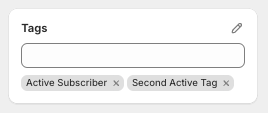
Example of Active Tags on a Customer Account
### First Time Subscriber
This tag will be applied to all customers who are first time subscribers to your shop.
### Active Subscriber
This tag will be applied to all customers with active subscriptions (Not paused, not cancelled)
### Inactive Subscriber
This tag will be applied to all customers who have no active subscriptions (All subscriptions are cancelled)
### Paused Subscriber
This tag will be applied to all customer who have no Actice Subscriptions (All subscriptions are paused)
## Order Tags
### Prepaid Orders
This tag will be applied to all orders that contain a prepaid subscription.
### All Subscription Orders
This tag will be applied to all orders that contain a subscription.
### New Subscription Orders
This tag will be applied to all orders that are the first billed order of a new subscription
### Repeat Subscription Orders
This tag will be applied to all orders that are repeat customers ordering the same items on a subscription.
## Advanced Tags
For more advanced tag features we have integrated with Shopify Flow, which will allow you to set custom tag events, such as tagging orders or customers when certain products are purchased.\
Please refer to our Docs on the Shopify Flow Integrations to see how this is possible.